BOOK REVIEW: Princess of Potential - Delemhach (2023)
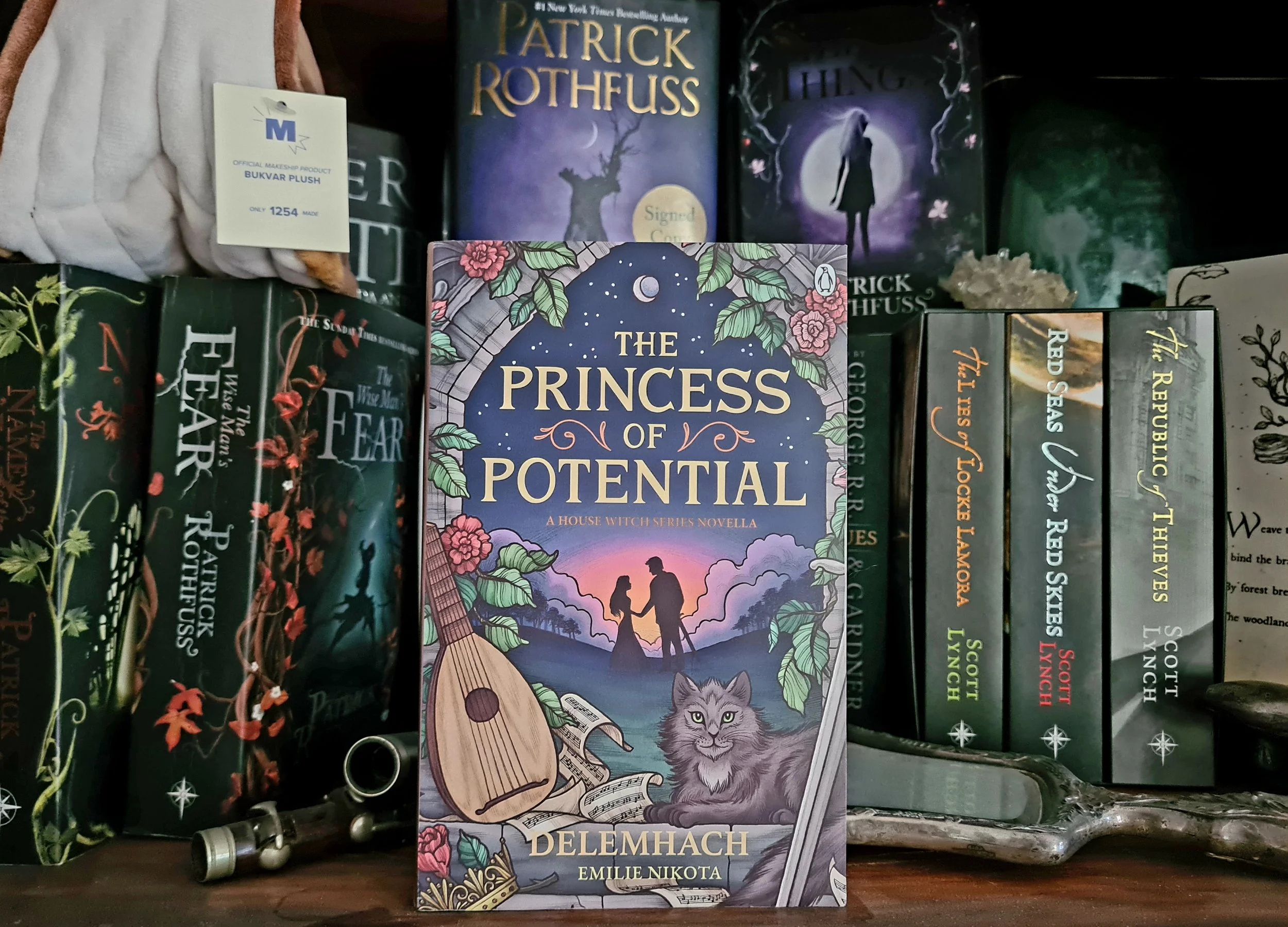
I will fully admit, sometimes I judge books by their covers. By that, I mean that sometimes I’ll pick up a fantasy book just because it has an interesting cover or because it has an interesting title. In the case of the 2023 novel by Delemhach (AKA Emilie Nikota), Princess of Potential, it was the latter.
Why? Because my partner and I had been talking a lot about potential, so the book name seemed to just crawl under my skin until I decided to see what it was about. I had no idea whatsoever that it was the fourth book in a series, The House Witch, so I was coming in blind to the world and its characters. Nevertheless, I found it to be a pretty fun read.
Premise
This is, of course, a fantasy novel, but it feels like it’s a regency-era romance novel in many ways, just with more excitement and tension. It is, after all, a very Pride & Prejudice -coded tale, of princess Alina Reyes beginning her courting to find a suitable husband. I enjoyed it because one thing I’ve talked about being tired of in fantasy is everyone always saving the world or saving the city or saving… something big. In this book, the conflict doesn’t ever escalate to that scale, which I appreciate, though it is far from devoid of conflict and action. To put it simply: not all heroes need to be saving the world. Heroes are, as Disney’s Hercules put it, measured by the strength of their hearts.
What I Loved
The overall writing and characterization was great. I really liked the characters, as they felt complete and unique from one another. Not everyone got enough pagetime for me to really get their motives, there was enough for the book to make sense, and I think any lacks are, simply, most likely caused by the fact that I didn’t read the first three books in the series first.
Also, I love me a broody Mr. Darcy-type male lead, and while he has moments of sexism, I found him to generally be pretty non-toxic in the way he treats the princess. I also love the unabashed love and adoration men express in this series. The Troivackians are, culturally, quite stoic people, but I loved that even they express emotion in their own way. Men who don’t apologize will apologize. People take accountability. They listen. It rules! The best part is that the characters allow one another to influence each other’s perspectives, which is a sign of healthy relationships, even if there are road blocks and traumas on their paths.
Another asset to this book, in the way it was written, was the way perspective shifts. It does move quite quickly—truly, it can shift between two characters during a conversation—and I have always worried in my own writing that this sort of thing would be a bit disjointing, so I tend to limit perspective to one character per scene, but seeing it in practice, I think it works really well to give the reader more insight into what all of the characters are feeling, not just one person at a time.
There were also really great examples of healthy behavior, like later on in the book, the princess goes into what is called “the soldier’s spell”—a phrase I loved—referencing someone facing a PTSD trigger and getting trapped in traumatic memories. How this gets dealt with is actually very sound based on human psychology, so I was really pleased to see it both expressed (fantasy characters often get over trauma way too easily), as well as the genuinely useful technique to help the character through it.
One of my biggest compliments to this book was that I wasn’t sure where it was going at any point. A lot of TV series these days, for example, can be very predictable, so I was pleased that at first, I saw three potential suitors for the princess but wasn’t sure who she’d pick, even though I had an inclination as to who it would be. Then, even when it was clear who her romantic interest was, I wasn’t sure how the story was going to end. And, once I got to the end, the story actually went on longer than I expected it to once the usual suspects (re: story arcs) were wrapped up. I’m not often surprised in narrative these days, so I really liked the pacing and release of information throughout this book, as well as the fact that not all questions were answered.
It also leads nicely into future books, as I believe I’ve read that Delemhach has moved onto The Burning Witch series now. It sets up a few cliffhangers, largely relating to the mysterious magic of Tamlin Ashowan, as well as the missing crown prince of Daxaria, leaving me wondering if I might need to continue reading her work. As well, I might also need to read the first three books in the series to get to know some of the other characters better. I am quite certain that I came across a few references to things that had happened in earlier installments but I had no idea what those things were, just an inclination that I would know if I wasn’t coming in at book #4.
The author also has a rowdy sense of humor—distinctly unfeminine, which I love—which doesn’t appear a lot, but does nevertheless appear, like in a rancid fart joke at one point. On that note though, there was a great—if a tad crude—joke in the book that the author undercut, which I’ll address in the next section.
And last, but certainly not least, was the character of Kraken (the house witch’s familiar), whose voice was so meme-coded that I almost hated him, except for the fact that no matter how internet speak-y he sounded, he made me laugh out loud every time he was in a scene. I wanted to hate it, but I couldn’t, he was just too funny.
What Could Have Been Better
As much as I really enjoyed this story, there were a few things that did grind my gears. My biggest gripe with this novel was the abuse of pronoun alternatives. I’m not sure if this was an effort to not gender her characters or what the reason was, but the book repeats the phrases “the noble” or “the royal” or “the redhead/blonde” to an oppressive degree, instead of just referring to the characters by their names or by pronouns. This got really grating really quickly, because repeat phrases tend to rub against the reader and it would have been so much more sensible to keep it simple and not bloat the text with continuously repeating alternatives. It draws attention to itself in an immersion-breaking sort of way.
Also, I earlier mentioned that the best joke in the book was completely undercut. This isn’t relevant to anything plot-wise, so there’s no need for a spoiler warning, but there’s a character named Richard Fuks, an Earl, who has a son named Les Fuks, who in turn has a son named Aster Fuks. As soon as I read this character’s name, I was like, “oh come on, what?” and then you find out that Dick Fuks is a cheeky old man who thinks his name is hilarious and thus has nicknamed his 4-year-old grandson “Ass.” All of this made me genuinely laugh, until there was one paragraph where the author explains the joke and ruins it completely.
Alina was so shocked that she barely remembered not to laugh. She had been warned by her father about Earl Fuks’s tendency to try to garnish favors from people who might find his name funny.
This paragraph ruined the whole joke for me (for the moment—it continues and then proceeded to make me laugh). Why? Because the author showed her hand. Until that moment, as a reader, I had been like, “wtf why is that guy’s last name ‘fucks’!?” Then she explains it, leaving me no more room to wonder if she had done it on purpose. If the story had just been a man named Dick Fuks going around looking for his grandson whom he affectionately calls “Ass,” that would have been hilarious and I would have spent the entire novel wondering about this author’s sense of humor. However, that sentence above ruins it by explaining the joke. I wish so badly that one line had been left out, especially since it doesn’t do a very good job of explaining the Earl’s motives, in the end.
There were also moments when the author describes what they people are wearing, and what they’re wearing is so uninteresting that it’s disjointing and throws me out of the immersion. Like, many times, the male romantic interest was basically wearing the same outfit—black tunic and slacks—and yet, the author feels compelled to continuously mention this, as if it’s relevant to the story. It never was.
Side note? This is just my boomer-esque editor voice coming out, so this is nothing against the writer but rather, just a stylistic nit-pick: I hate the modernized versions of things that I was taught were wrong when I was young, so I’m the type of person who uses “Earl Fuks’ tendency…” instead of “Fuks’s.” I tend not to like things that get modernized simply because the majority of people didn’t pay attention in English class. But once more, this is 100% a personal problem and preference, but I just don’t like it and even though in this day and age it is technically correct, it reads as bad grammar to me. Granted, I’m sure it doesn’t bother most people.
What Would I Like to See?
This is again an entirely personal thing, and it’s the same thing I would ask of any writer with feminist inclinations. I get the impression that Delemhach is trying to be a bit feminist in her writing: Daxaria has a culture where the king is in charge but the princess gets to choose her partner, it’s not decided by her father. The Ashowan family are very close and speak openly and communicate well (for the most part), with the mother being a powerhouse in her own right. There’s a push for feminism in Troivack from its own king. Hell yeah, great start!
But, all that said and done… the author has still chosen to write in a patriarchal world, and I am admittedly pretty fucking tired of patriarchy, so I’d love to see talented writers like this, who do push for equality in their storytelling, to try to write a culture that’s not based on something you know. This is just my personal desire as a feminist, of course, and I think she did a brilliant job with the regency-era styling and I don’t think the book suffered for it at all, I just think this writer would possibly come up with something quite profound if she were so inclined to do a bit of reading into feminism and, instead of showing us a nicer version of patriarchy, explore something that’s not patriarchal at all.
Overall
While I did find some minor grievances in the writing style, I did really enjoy the story! I picked this book out of my pile with the plan to read a chapter a day, just to push myself to read more—I used to read about 25 books a year until COVID and then for some reason, despite having more time than ever, I stopped reading anything but daily webcomics. On the first day, I read the first chapter. On the second day, I read three more chapters (hey, they’re pretty short!). On the third day, I finished reading the book because I was engaged enough to not want to put it down. From someone who doesn’t read a lot anymore, it just goes to show how quickly I became invested in these characters and was overall very satisfied with the way things worked out. And I’m definitely interested in reading more from this author, which is about the best job a novel can do!
Curious about Bear’s fantasy? Check out the teaser sample of The Vitmar Chronicles, Volume I: An Ending & A Beginning!
