BOOK REVIEW: The Blade Itself by Joe Abercrombie (2006)
Books 1 of The First Law
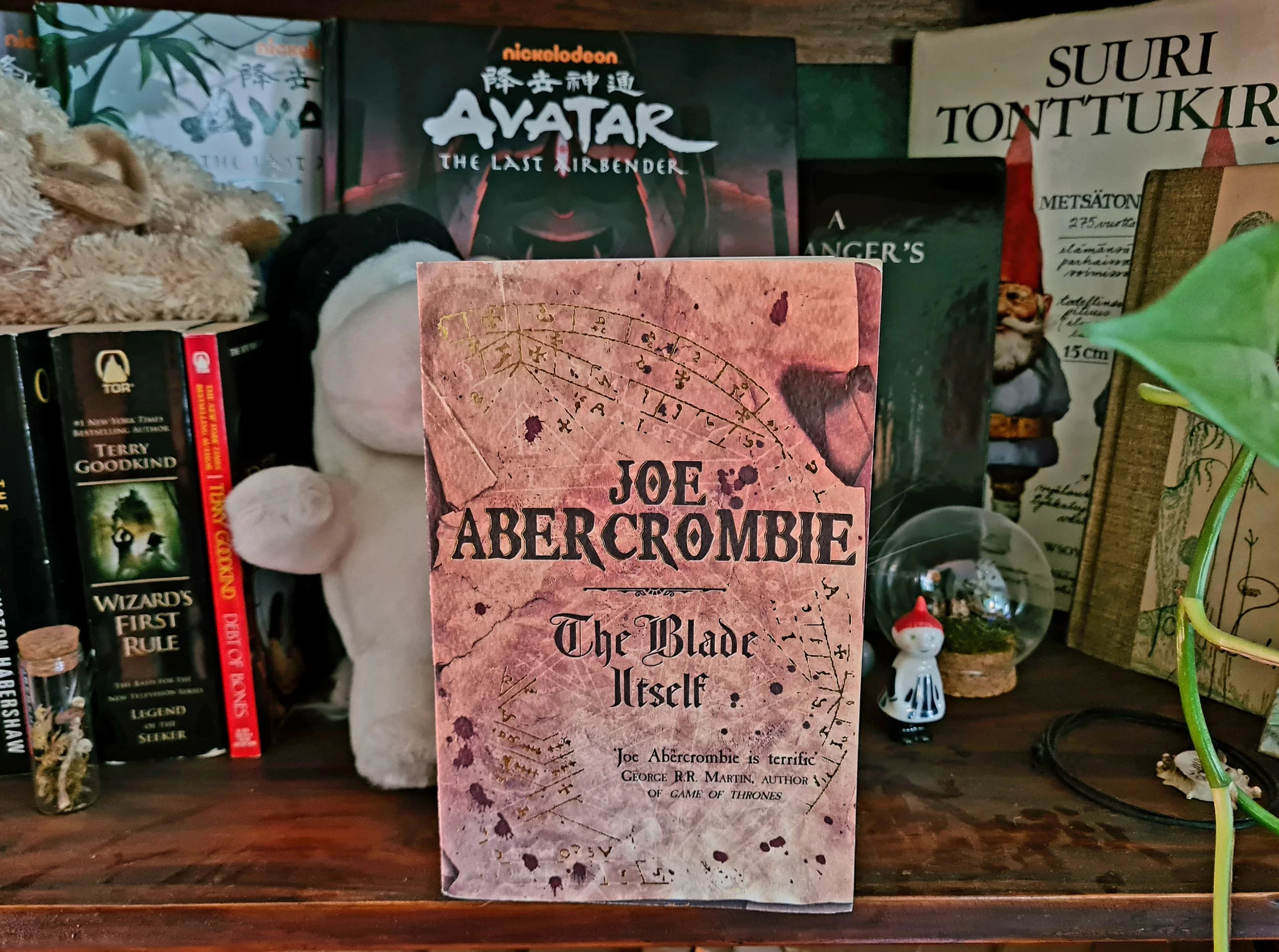
I hate to say that it’s been years since I’ve picked up a novel to read, but here we are. Before last fall, I hadn’t touched a book since before the COVID years, it seems, which is a bit of a tragedy. In an effort to rekindle my love of reading and writing, back in 2024 I thought I’d go to my literary wine cellar (aka bookshelf) and select a vintage that I’ve been holding onto for some time. I opted for Joe Abercrombie’s The Blade Itself, which was released back in 2006 as the first book of The First Law series. Abercrombie has always come highly recommended by both friends and authors that I like, so this felt like the right time to pull him off the shelf.
And yes, as of starting to write this and finishing writing it, about 2 years have passed. So, while I did pick up a book, I also put it down again, picked it up again… rinse and repeat, but I did finish this book up in 2025, and now in 2026, I’m rediscovering and subsequently finishing the review I started up when I first got into it.
Premise
Would you believe me if I told you that, despite having finished the book, I actually couldn’t really tell you what the series is broadly about? I could tell you that it’s got three main characters: Logen Ninefingers, who’s a grizzled old war veteran who’s not sure he still deserves to be alive, but is, nevertheless. Jezal dan Luther is a spoiled young layabout who’s never cared enough about anything to work for it, until he falls in love with Ardee, a woman below his station, and decides to prove himself in a sword-fighting tournament that he had so far been half-assing his training for. And finally, my personal favorite, Sand dan Glokta, a torture victim turned torture artist who’s one of the most compelling and gripping characters I’ve probably ever read.
These three characters have intertwining stories as the northern barbarians encroach on the empire, whose king seems to have miraculously been a depiction of Donald Trump circa 2026, despite the book having been released originally two decades ago.
However, this very long book seems to have done little more than set the chess pieces in place for what is to come, for better or for worse.
What I Loved
Glokta, straight-up. I hated Jezal, still do. His patriarchal bro bullshit with status as he whines to himself endlessly about his feelings for Ardee despite her definitely super not being good enough for him (let’s be clear, she’s way too good for him)? Douchebag who’s surely going on a redemption arc and maybe I’ll like him by the end, but for now, just fuck right off out of this story, you worthless shithead. Logen, I like, though the spelling of his name mildly annoys me—is it an old-school fantasy writer thing (lookin at you, Martin) to take a normal name and change a letter (looking at you, Eddard Stark, Jaime Lannister, and so on) and that makes it fantasy? Anyways, I digress. He’s got the sympathetic nature of a war-ravaged vet with more blood on his hands than he’d like, who’s since been rejected by the warlord he once served. The war vet with a heart of gold is a bit of a bored trope at this point, but Logen still manages to be interesting and likeable and you feel like you want to know what life has in store for him after all he’s been through. Solid character, and the addition of first mage Bayaz to his arc was great, because Bayaz has the charm of a confident fellow who’s very powerful, but Amercrombie made sure to show off pretty quickly that this power has very real limits. Bonus points for the magic not being remotely flashy.
But in a story where I don’t really know what’s going on? Glokta was the reason I kept turning the pages. There’s a moment when he’s doing his job and his victim is offering him wealth, whatever he wants, anything, to prevent the upcoming torture. But what does Glokta want? His teeth, the functionality of his legs, his life and health… all things that fortune and status can’t fix. I felt like, without really knowing what that character looked like, I could see the realization set into his face as he knows that there is nothing he can do to bribe his way out of this situation. This makes Glokta one of the most brilliant and terrifying characters I’ve come across in some time. When you see his victim again, the change is stark.
Was it a good story? Overall, sure, yes, I did enjoy it, especially after the two thirds point when it picked up pace a bit. But again, it’s hard to say too much when you know that the book is really just the prequel for what is to come.
While Abercrombie’s not a poetic writer by any means, his descriptive work is very good—not too wordy, yet vivid enough to paint a picture. He doesn’t drag on with endless detail like Tolkien, nor is he romantic/poetic like Patrick Rothfuss, but rather, he describes things succinctly and to-the-point in a way that I find clear and cohesive. It’s dressed up well enough to keep things engaging without being superfluous. In exciting moments, I didn’t have to slow down to figure out what in the arse he was talking about.
The book is a big one, but it does a reasonable job of compelling you forward. A few of the characters are immediately… maybe not the most likeable, as mentioned, but you feel interested in knowing what’s happened to them, to lead them to where they are in life, or in the case of one certain spoiled shit, you wonder what’s going to get him to grow up. This creates a nearly instant compulsion to keep reading, which I have found lacking in, for example, The Stormlight Archive from Brandon Sanderson, which I confess to abandoning about halfway through.
What Could Have Been Better
Off the bat, for the first few chapters I wasn’t a big fan of Abercrombie’s prose style. He had a choppy, blocky way of writing that I found grating (even if it was likely meant to reflect the characters’ ways of thinking), but what was stranger was that this seemed to stop after the first handful of chapters and my editor’s irritability went away quite quickly.
I also learned something about myself when reading this book, which is that I find white men writing about war-torn fantasy worlds that reflect the worst parts of our own to be extremely… basic. As in, it’s been done. And done. And done a million more times. I feel like white male fantasy authors really don’t write about anything else, except maybe Scott Lynch and Pat Rothfuss (okay, or maybe I don’t read enough to know more names to be totally fair in this assessment, but it is still super common and pretty done to death).
And then, in those types of stories, the romances are generally dull and rely too much on will-they-won’t-they rewards for men who are usually objectively douchebags. Ardee is a great character, but she’s still a side character in a story about men doing man things, and as a female writer and reader… I’m pretty over that. I’m also tired of the one decent female character in the whole book being the love interest of a dude who’s a worthless slack-off nepo-baby, who’s probably going to become a better person for her, even though that’s not how people tend to act in real life. I’m sort of over male wish fulfillment.
Perhaps it’s because all of these big-name fantasy writers spend most of their spare time reading each other’s work? Granted, you have some authors, like George R.R. Martin and, I daresay, Joe Abercrombie, who (at times) do this spectacularly, so I won’t poo-poo a good story about a war-torn fantasy world by any means. This was one of the better ones, I admit it! You can do these stories endlessly as long as you’re creative about it, and they’ll always be a good read.
So don’t take that as encouragement to disregard this sort of fantasy. I’m just saying that even though I enjoyed this book enough to finish it, personally, I noticed when first starting this review that I might be looking for something a bit different nowadays, because this field of fantasy is, as far as I’m concerned, about as oversaturated as the Finnish metal scene. And I was right, because I’ve been reading more cozy fantasy in the stead of these long high-fantasy epics, and I’ve been enjoying my reading time more and it’s been less of a chore to read fantasy novels in general.
I will admit, however, that the setup for the book didn’t really get me rip-roaring to continue the series. I liked it, yes, but I have no idea if I’ll ever open the second book. The story didn’t exactly pick up in a way that had me dying to know what happens next; rather, I just liked some of the characters and have some degree of curiosity to know what happens to them.
What Would I Like to See?
One straight white male, just once, to write about fantasy in a world that’s not patriarchal. This isn’t really a complaint about Joe Abercrombie, but more of a complaint about the lack of inherent whimsy and fantasy in… fantasy. I could go on a feminist rant right about now, but I suppose guys write what they know and when they’ve not had reason to fight against the system, they inadvertently upkeep it. When all we read are stories about underclass women being pissed about their situation and snotty, spoiled boys who don’t know what love is because they’re too full of themselves… how do we learn to be better?
Again, take me with a grain of salt because I haven’t finished this series, so I don’t actually know the full character arcs. If Ardee ends up shooting Jezal down hard, I’ll respect Joe all the more for it. And of course, he can write what he wants to write, because he’s very good at it. And when it comes to these sorts of fantasy worlds, this one is actually one of the least gross that I’ve read, so that’s something. I’d just love for people to challenge the status quo once in a while. That’s more of a broad critique about mainstream trad-pub’d fantasy, not really Joe’s work specifically.
Overall
I feel like I maybe talked more smack than I meant to, but forgive me, because I didn’t realize that I picked up this review that I started in like… ‘24 and finished a year to half a year after I finished reading the book, and then another 6 months to write the review, so it’s a little all over the place. I actually really enjoyed this book on the whole, largely due to a few interesting characters (Logen, Bayaz, Glokta), because admittedly, the overarching wars and intrigue don’t really do much for me these days. I’m more interested in character stories, as my more recent book reviews may have suggested, rather than hero’s journeys. So take me with a grain of salt as someone who’s bored of save-the-world stories and prefers to read simpler tales. But if you’re into that sort of big, heroic, epic fantasy? This is probably one of the better series I’ve started in a while.
Enjoy Bear’s writing, which uses ZERO AI? Consider joining her mailing list to keep up-to-date!
