GAME REVIEW: Split Fiction
If you browse my game reviews once in a while, you’re surely aware that my partner and I are on an endless quest to find good couch co-op games to play together. Tragically, due to the rise of online multiplayer gaming, devs tend not to focus so much on local co-op unless it’s games for, well… children.
As such, we were pretty enthusiastic to try out Split Fiction, a game from Hazelight Studios and published by EA Games in March 2025 to pretty rave reviews. Our experience, however, was fairly mixed…
Plot
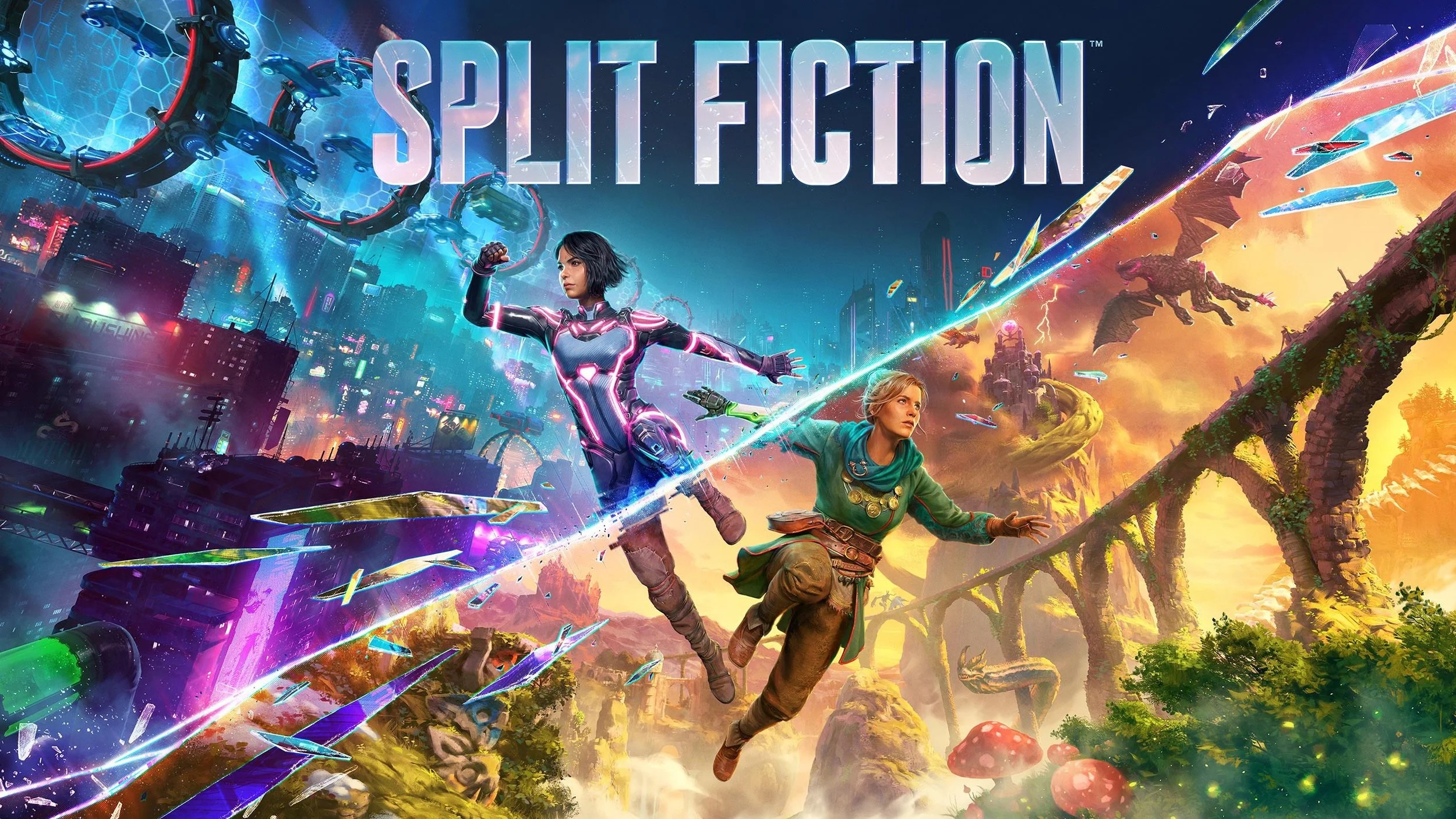
The story is about two characters, Mio Hudson and Zoe Foster, who are both aspiring writers who were offered a publishing deal by Radar Publishing and already have a contentious meeting on the elevator, as Zoe is perhaps a little too open and chatty with strangers, while Mio is extremely antisocial and closed off, setting up the enemies-to-friends route before the player has a chance to even know what game they’re playing.
When they arrive at the meeting, they realize that this isn’t a normal publishing deal, but they’re all asked to enter some sort of machine. Mio panics and decides she doesn’t want to participate any longer, but in the chaos, she and Zoe end up in the same machine—something it was not designed to handle. The duo must then proceed through simulations fueled by their own creative ideas that follow plots of stories they’ve once made up, as things in the real world get progressively more sinister.
Gameplay
We were pretty hot and cold with this game’s mechanics. It has a lot of pluses and minuses. For example, one of the most fun parts of the game is how many video game genres it explores. For some people, I can imagine this is frustrating, if you only like certain types of video games. There’s platforming, there’s sidescrolling, there’s action, there’s a lot, and it’s pretty fun.
There are a lot of places in the game where it’s really fun. The baseline mechanics that were consistent throughout the game were solid. Every world, however, has a trick or quirk to it, and those could be great or confusing. There was a lot of creativity put into this aspect of the mechanics though, so I respect that. It seems like this is where the developers put the most effort and had the most fun.
The issue I have with the gameplay is in its inconsistency. On the plus side, they do give you reminders of what buttons you should be pressing to do things, which is good if you pick up and put down the game a lot (I forgot the button mapping twice due to long gaps in our play sessions, but never had to look anything up). But the balance was really off—some segments were extremely fun but others were tedious, messy, or outright confusing. There were a lot of places in the game where we figured out the trick, but it took too many times to get right due to the button mapping or lag or other reasons that should have been fixed during testing.
There’s also the issue of tension and risk. The characters are emotionally terrified of the situation they’re in (sometimes, when it’s convenient for the dialog). They don’t know where they are, what sort of danger they’re in, etc., but in the gameplay, there’s really no consequences for fucking something up. Just do it again. And because it’s a mandatory 2-player game (as in, no single player mode), there’s not even consistency in failure. Sometimes you reset at a checkpoint, sometimes you respawn in the middle of a sequence. It makes sense per the game, but it undercuts the tension the characters are feeling, somehow, that if one of the ladies dies, they just sort of casually catch up with the other. We’d even skipped parts of sequences at times because one of us died and the other got too far ahead.
I did appreciate that there were checkpoints within big boss fights (excluding the final boss, though). Some of them were a bit tedious/long and I was glad we didn’t have to start from the beginning. In that sense, I think the game’s flow was actually really good and didn’t force you to redo things too often. That was perhaps a risky move but I think they pulled it off well.
On the whole, I think the gameplay was pretty fun most of the time and I liked a lot of the ways wherein you had to work together to proceed at times.
Art & Style
Spectacular. Just spectacular. Colors, atmospheres—all very nice. This is the best part of the game. If you just want to play something pretty, I can recommend this thoroughly. Especially towards the end, when the sci-fi and fantasy aspects start to blend together, the art style is really fun.
I can’t say the music or sound effects stood out at any point (I doubt I’ll be looking up the OST to listen to), but they were very suitable for setting the mood and creating atmosphere.
Story
Here’s where I’m going to get a bit… hmm. You see, this game has some of the literal worst writing I’ve ever come across in a game that didn’t have a terrible story. Spoiler warning from here on out in this section, but frankly, this isn’t a deep enough story that you should really worry about it. If you play the intro, you can almost certainly figure out immediately how the story is going to proceed.
Let me paint you a picture of how weak this is…
Zoe is a very outgoing and positive person, who likes fantasy, while Mio is very closed off and pessimistic, and likes sci-fi. Immediately on meeting them, these soggy one-dimensional ladies spread their character arcs out in front of you. They’re the definition of archetypes. Their dialog is atrocious and there is no depth or nuance to anything they talk about. They’re just designed to be the exact opposite of one another because… the game needs them to be, because that’s what the whole thing is about: opposites finding sync together. Zoe is annoying, Mio is a dick.
But, I can write off weak dialog if the story around it is strong enough. What really hit me up front was that the premise for the game makes literally no sense and is just… beyond unrealistic.
So, as I said in Plot, these two aspiring writers are offered a publishing deal by Radar and show up to what they both believe is a meeting with the publisher, but what it actually is, is a group of writers who were brought in to participate in an experiment with a massive piece of tech. They are given literally zero explanation of what this machine is, what they’re doing in it, and why. None whatsoever. And everyone but Mio thinks this is fine and normal and just go along with it, despite being totally blindsided by this complete left turn.
There’s an implication that writers are so desperate to be published that they’re willing to do literally anything, including going into an invasive tech experiment with no idea of the risk or rewards of doing it. Not gonna lie, as a writer, I take a bit of offense at that.
Points to the fact that this technology is not actually doing what they said and is, in fact, stealing the ideas from these writers’ subconsciousness, which feels like a pretty good jab at the current state of gen-AI tech. If only the story didn’t feel AI-written (that’s not an accusation, to be clear, just a comment on the quality).
It’s just… so unrealistic that it put me off the game right off the bat. Don’t get me wrong, video game, fantasy/sci-fi, suspension of disbelief and all that, but things still need to make emotional sense. This game doesn’t do that. There’s truly no reason that any of those people should get into that machine without any more explanation from the company beyond “this is my life’s work that I’m obsessed with and I’m so excited to share it with everyone!”
To make it even worse, as they get started, Mio is the only character with half a brain cell and thinks this is weird and suspicious. She decides she doesn’t want to do it anymore, and the people at the publishing/tech company just… decide to force her.
Once again, this just makes no sense whatsoever. Nobody has signed a contract at this point. No tech company on earth, would invite someone to an experiment, not explain it, and then force someone to participate. Why? Because tech companies, no matter how insidious their motives, need to look good to the public, and this is just purely unethical. It’s psychotic behavior.
So, drama, blah blah, and Mio accidentally ends up in Zoe’s simulation bubble thingy and the people on the outside are freaking out because the machine wasn’t built for this. Meanwhile, Zoe’s in a fantasy world she made up and Mio shows up. They start arguing again, in the most generic, uninteresting tropey way you can imagine. It’s all very tell-don’t-show and… it’s just really bad dialog. You can predict what they’re going to say half of the time before they speak.
The player is then forced to listen to a toxically positive asshole overshare to the obnoxiously closed-off asshole, while the latter refuses to explain anything that will help them possibly prepare for what is to come. At least until the last moment. Because that would spoil things for the player, so instead of writing better, they ask relevant questions and then just keep dropping/not answering them. It’s really frustrating.
Now here’s the odd part. The story itself isn’t bad, it’s just that they didn’t put much depth into it. Again, spoilers, but both of the main characters have some sort of internalized grief that’s honestly pretty obvious from the get-go, but they draw it out until the very end so that the characters have the chance to bond with one another over it. And you know what? It’s not a terrible story when you get to the end. Both of the main characters have to combat their own inner worlds by the last few chapters of the game and that part is actually pretty cool. I just wish the dialog had supported the emotional depth of the story.
And then we have the villain, Mr. J.D. Rader himself. Gawd what a horribly written character. He’s basically Elon Musk meets every sci-fi movie supervillain ever written, but without a sensible motive. He seems like a decent person up front, until he goes full “RAWR THIS IS MY LIFE’S WORK, THESE TWO CAN DIE SO I CAN ACHIEVE GOD-LIKE POWERS IN MY DIGITAL WORLD RAWRRR!” and… why? So we have yet another patriarchal man seeking dominance and power at the expense of all others? I’m so sorry, but this has been done a million times—and to be clear, that’s okay, tropes exist for a reason. But come on, give the man some motivation for the sharp left turn into psychopathy, please? If he had just run around the screen screaming “I AM THE BIG BAD EVIL GUY RAAAAH!,” I don’t think I’d have felt differently about the dialog.
The reason this bothers me so much is because he keeps doubling down as everyone else in the real world abandons him. There are a few staff members who stick around for no explained reason despite their clear discomfort with how things are going, and the corporate overlords eventually see that Rader is a lunatic and call the cops on him. So he throws the two remaining staff members out and then puts the building on lockdown, meaning that a bunch of barred doors close? Because they built their building with lockdown cages?
Then, at the very end of the game, the police show up (of course) right after things are already taken care of, and Zoe and Mio just walk out of the smoking building and nobody stops them. The cops don’t question them or take statements, nothing, they just leave.
And once again, I know I’m playing a video game, but what’s wrong with having narrative depth? The enemies-to-friends (hell, I’d have been all for it if this was an enemies-to-lovers story) arc between the two MCs was actually kind of decent, it was just really painfully generic and written in a really boring, basic, too-familiar way. This could have been a really cool story if they had put a bit more effort into narrative quality. This feels like a first draft that needs to be fleshed out far more than a finished product. As I said, it seems like they spent a tad too much of their creative budget on gameplay, and not enough on the story itself.
This Game Wouldn’t End
So, even though we weren’t having the best time with this game due to the quality of the writing, we did commit to finishing it. This meant that we stopped doing the “side stories” (side quests) and just committed to finishing the main plot.
Most of the game is about the MCs chasing “glitches” in the system, so you would think that, once they’ve been through all of the stories they have inside their minds, that final glitch would take them to the end boss. Nope! Not yet! Then you have to go through a generic sci-fi and fantasy world each, to deal with each character’s subconscious traumas. Then, the sci-fi and fantasy worlds mash together and you keep going, to finally get to the end boss.
This game was, perhaps, longer than it needed to be. Or perhaps better dialog would have made it less tedious to finish. Either way, I remember getting through the main levels and thinking, okay we’re almost done, only to have to do another five or so levels still before reaching the end, and that was fairly annoying when we were already sort of done with the game. The ending felt pretty needlessly drawn out.
Ultimately, I don’t actually feel like the game was too long though, objectively. This was just another issue in the narrative and to a lesser degree, gameplay. If the story had been written better, I would have enjoyed being in the world more. But because the villain’s motives were so one-dimensional, the ending felt drawn-out and tedious.
Overall
If you’re not too arsed about dialog or story, and you’re just looking for a visually attractive game to play with someone, this is kind of a cool game, conceptually. The gameplay is smooth most of the time and it’s really visually stunning, even if the fantasy and sci-fi tropes are pretty generic.
However, if you’d like your games to have narrative depth or quality storytelling, this one might surely leave you a bit disappointed.
On the whole, as a couch co-op game, we did have some fun with it, but we’re both the type who like a full-spectrum package, meaning gameplay and story, and this was definitely a very mixed bag across the board.
