ILYNIKA:
THE WORLD & CULTURE FROM
THE VITMAR CHRONICLES

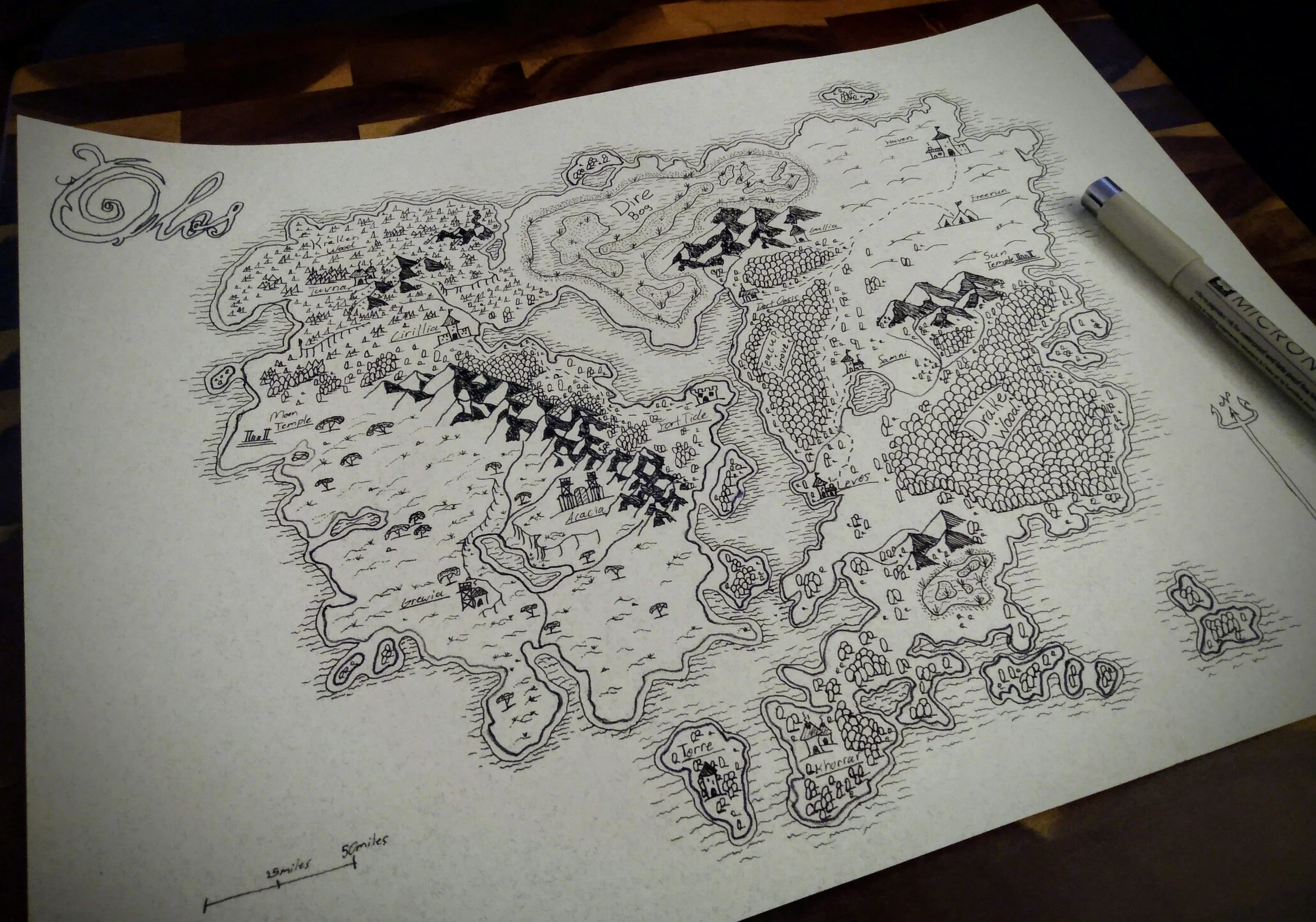
Ilynika as a Setting
I have always loved making up worlds. When I was originally writing my 13-book series, The Tomes of Ra, the reason there were so many stories was because I needed different worlds for all of my unhinged ideas. Every time I came up with something new, it had to become a new story and world, because it was too cool for whatever I was writing at the time (can you tell I had undiagnosed ADHD?).
The world of Ilynika—which I’m certain was derived from Ilyria from Twelfth Night—was a bit of a different take on worldbuilding. I felt strongly about creating a world that’s kinder than our own, because we have enough examples of dirty mirrors in our lives, but not enough positive examples of how to do things better. I didn’t know much about political theory at the time (arguably still don’t), but I was happy to work backwards from what not to do.
As such, most of Ilynikan culture is very different from our own, save one place, which might feel more familiar: the largest island of Andranei is a patriarchy with a culture derived from all of the worst aspects of human society and history. Then, there was an exodus at the end of the 2nd Era, during and following the War of Doors, when the oppressed peoples of Andranei got fed up and decided to start over and build new settlements away from Andranei.
This meant that most of my settings were inspired by my desire to live in a better world than the one we live in, so many of my quirks, beliefs, and morals have seeped into Ilynika’s soil.
Ilynikan History
The history of Ilynika is divided into four distinct Eras: Era Nol, 1st Era, 2nd Era, and the present-day 3rd era, which is in its 233rd sun turn (year) at the start of Volume I.
Era Nol is the time before recorded history. Ilynikans know that there was life on Ilynika before the 1st Era, but they do not have any knowledge about it, as there are no recordings of what happened before the Eldren and later Kadrakkis appeared.
The 1st Era marked the appearance of Eldren, Kadrakkis, and the Elder Deities, who are great creatures that migrated to Ilynika from the multiverse. The Eldren built settlements, the Kadrakkis took over the largest island (namely, the island that would eventually be known as Andranei), but the two main species never found peace between their lifestyles as the Kadrakkis considered the Eldren inferior… and edible.
Eventually, the ongoing war drove the Eldren to push for complete eradication, to claim Ilynika from the Kadrakkis. Their plan worked, eradicating the Kadrakkis from Ilynika, but not without the Kadrakkis leaving behind a curse, wherein no two Eldren shall ever again conceive on Ilynika. This has remained true to the present day.
The 2nd Era began when the Kadrakkis left Ilynika and their departure accidentally allowed humankind through, landing in Andranei and taking over the land that once belonged to the Kadrakkis. Meanwhile, the Eldren were in crisis over their critically diminished numbers and newfound infertility. Eventually, via the romance between Eldren Tarias Nivekorpi and human Livena Wynn, the Eldren realized they could breed with this new race, passing on their blood ability to connect with the energy of Ilynika, though they could not pass on their immortality. The already critically diminished numbers of the Eldren died out for various reasons, with the existence of survivors now being left to speculation and myth.
The 2nd Era marked the rise of humankind and magic, as humans learned from the Eldren how to access the multiversal doors. However, when the Eldren died out and humankind were left unsupervised, the unchecked exploration of magic and the multiversal doors led to a fracturing of the multiverse. The instigating parties ceased their combat and spearheaded the effort to stitch the multiverse back together. However, this was after the surface of Ilynika broke apart and was chaotically reassembled. Imagine smashing a bottle and then scooping the pieces into a pile—that’s what happened to the surface of the planet. It’s all there, but nothing’s even close to where it used to be.
During the end of the 2nd Era/beginning of the 3rd Era, many of the oppressed peoples of Andranei (including many mages) fled Andranei with a hope of starting over, without bringing their patriarchal culture with them. As such, many of the cultures of Ilynika are based on my different ideas of how we could, as a society, take better care of one another. The cultures outside of Andranei are focused on community, mutual care, and service to one another. This means that the Isidoran King was turned into the Patron of the Realm, someone who—much like Scott Lynch’s Gentleman Bastards—spends their life in different trades and communities, learning as broadly about the world and everyone in it as possible, so they are best-educated to serve their people. The Patron’s Apprentice may come from anywhere, as the role is not necessarily passed down.
At the series’ present day, in the 3rd Era, much of Andranei’s population has spread throughout Ilynika. Ties with Andranei are trepidatious to say the least and trade and travel are fairly limited between Andranei and the rest of the world. The island cluster of Port Cross is the designated landing point for merchant vessels, acting as a barrier between the hostile lands and the more peaceful north. However, barbarian raiders and other invaders do still find their way north to cause trouble from time to time.
Cultural Expectations for the Reader
Outside of Andranei, which should feel uncomfortably familiar on the rare occasions the series visits that island, there are a lot of cultural norms in the rest of the world that are worth saying up front. Why? Because one of my ARC readers mentioned how suspicious he thought a lot of the characters in Volume I were because they were so up front, honest, self-aware, and willing to trust gut instincts. It occurred to me that I’ve made a strong effort to portray this culture in a show-don’t-tell manner, but that means people reading it without context won’t know that this is my take on a kinder world than the real one, so I understand why it might come across as deeply strange and suspicious.
Ultimately, this series is my exploration of what a world might be like if integrity was at the baseline of culture. So people, broad-spectrum (outside of Andranei) should be expected to be honest, accountable, up-front, self-aware, kind, and helpful. The point of this is to show that much of the way we behave is taught by our societies and that our behaviors and actions are choices. We could choose to be kind and helpful, instead of cruel and judgmental, and this is my effort to show off what the world would be like if this was the choice that we all made by default.
Naming Conventions & Pronunciation Guide
I am a linguist by degree, ergo different regions from Ilynika have different inspirations. For example, Isidor and Eayl are largely Germanic, though Eayl also has a special quirk to its naming conventions that I’ll let you guess for fun. You won’t be able to un-hear it once you figure it out. Isidor is one that I try to be a bit more flexible/creative with, while keeping at least a baseline of Germanic pronunciation. Terysia and Miklyria were inspired by folk metal and my move to Finland, ergo their languages are loosely derived from Finnish and Swedish, while Nordvahl is more Scandinavian in inspiration. Terysia, incidentally, has a quirk unique to the naming convention of its cities, which you’re welcome to guess as well. The frozen northern islands of Shen’lai are mostly Eastern Asian -influenced.
The Nivekorpi island of Korvisár takes influence from Finnish, French, and Latin (niveus = “white” in Latin, korppi = “raven” in Finnish, though the word “korpi” has a different meaning; Korvisár then takes the “korvi” from “korppi” and “sár” from the Finnish word for “island,” “saari,” but dropping the “i” and using the “á” to express the Finnish-style double-“a”). Meanwhile, Amelie’s name comes from French.
The strangest quirk I included in the worldbuilding was my replacement of the words “year,” “month,” and “week” with “turn,” “pass,” and “span” respectively. These are shortened forms of “sun turn,” “moon pass,” and “day-span.” “Day” still means the same thing, because I didn’t want it to get too confusing (and then I’d have to change words like “yesterday,” which felt like too strange of a change to make).
Most of my main characters’ names were chosen by the person who inspired them, such as Gabriel, Kaldor (the chosen name was “Kelgor” but I had a hard time believing parents who named their first son “Gabriel” would choose “Kelgor” as their second choice, so I softened it to “Kaldor”), and Aelwynn. Vitmar is a fantasy take on a real surname. Amelie was chosen by me, because at the time I was really obsessed with the songs “Lovelorn” and “For Amelie” by Leaves’ Eyes. Karanne and Gwenrósa, and one thus-far not introduced character, Ylmar, were all named by my real-life friends who inspired the characters, while Kelton, Clinton, and Kelvin have the same or similar names to their real-world inspirations.
I do want to put a quick disclaimer in here as well, because many people say it’s weird to base characters on real people. That’s fair. My characters were inspired by real people, not based on them. My characters do not behave in the way their real-life counterparts behave, and I’m sure the people who inspired these characters 15-20 years ago have significantly changed as people as well and might not see themselves in these characters in the slightest. Rather, when I was looking for types of personalities, or when I was inspired by, say, a relationship, those were the elements I implemented into my writing.
As well, some characters, like Gwenrósa, were written for/with a friend, but with the desire to inspire them in some way, shape, or form.
Regarding pronunciation, I definitely didn’t want to go too hard into the notorious realms of fantasy and sci-fi names. My goal was to make sure people like my dad aren’t rolling their eyes too hard at the character names (my dad absolutely does not read fantasy unless it’s written by me). The only particularly noteworthy part of pronunciation quirk is that I took the older pronunciation of “ae” to be “i”; so Aelwynn is pronounced the same as “isle-win,” not “ale-win.” Also, over in Terysia, the Finnish convention of an accent equating a double letter is worth noting. “Korvisár” would be pronounced with a long “korvisaar,” like a Finnish double-letter.