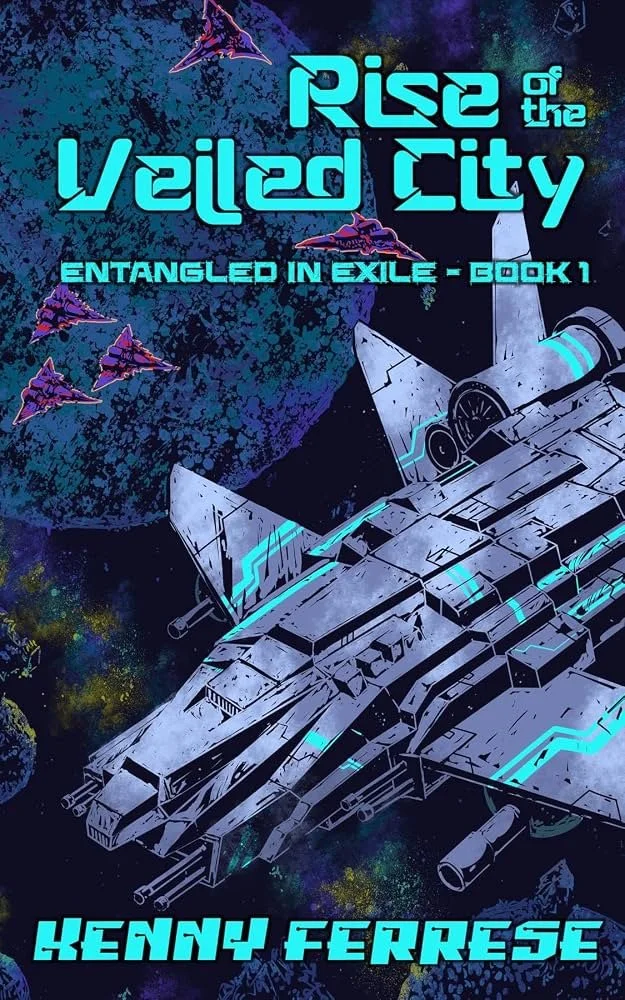
BOOK REVIEW: Rise of the Veiled City (Entangled in Exile, Book 1) - Kenny Ferrese
Earlier this summer, I was open to doing some review trades with other authors and one that popped up was the first book of the Entangled in Exile series by Kenny Ferrese, called Rise of the Veiled City. This was a fairly fast-paced, fun sci-fi epic adventure—not usually my jam, but if it’s well-written, I’ll enjoy more or less anything, so I decided to give it a fair shot.
Worth noting that I am a developmental editor and beta reader, so I often have a lot of feedback.
Premise
Rise of the Veiled City follows main character Curro and his friends Regina and Min, as they grow suspicious of their leader’s behavior after a local festival. Curro and Regina are fairly competent new recruits on the fast-track in the military, while Min is a miner. Their people had fled their homeworld of Krythe to hide on the planet of Gan after a hostile alien invasion approximately 40 years prior, so when Min’s family disappears, his friends begin to question where their loyalties truly lie, and what their dictatorial leader is really up to.
What I Loved
This is a really well-written book, prose-wise. Almost every scene was written clearly and concisely, without anything too flowery that would be distracting, while also being emotive enough that it’s interesting to read. There were very few scenes where I had any confusion over what was going on, and that was usually my fault for reading too quickly and going back cleared things up.
It’s also a compelling tale. The pacing is brisk enough that I didn’t get bored (the beginning parts could have been boring, but they weren’t). As someone who is very rarely interested in sci-fi books (the fantasy aesthetic just does more for me), I was really pleased. The 2000s version of Battlestar Galactica is one of my favorite series, and this story does have a similar “we must flee our homeworld because of invaders” idea, though it’s aliens not AI and they did find a new settlement, so it did tickle something I have enjoyed in the past in the sci-fi sphere.
The action scenes were fun and interesting, too. There’s a lot of telekinesis and telepathy in the stories and the lore surrounding it is quite solid, so it’s always fun to see what happens, why, how it’s affected by others/enemies, and so on. Really intriguing material.
Furthermore, I’ve noted that, particularly amongst male writers, they often speed-rush through recovery periods after battles, be it emotional or physical, and that hasn’t been the case in this book so far. In fact, Curro isn’t even involved in the final battle, because he’s in recovery from a nasty wound.
What Could Have Been Better
If I had been beta reading or editing this book, there are a few things I would have tidied up:
Firstly, I’d have cut the scene where Curro reflects on his infatuation with a character whom I can just assume he’ll get together with eventually (because that’s how this always goes). It comes out of nowhere, it hasn’t been hinted at before, and it has no relevance to anything in Book 1, so it feels tacked on to tell us that this is the love story we’ll be seeing eventually, without actually pushing anything relevant in this story forward. It serves nothing and feels forced, so I’d drop it.
Next, in the first few chapters, one character is referred to, point-blank, as a dictator. I would have encouraged making this character a bit more likeable early on, so that the discovery of their insidious side would come as a surprise. Not to say that this was a poor plot point, rather, a missed opportunity to create tension and uncertainty. It was an interesting move to label the character as such up-front and I’d be curious to see how that develops as the series progresses, if nothing else.
Thirdly, did you know that 43% of American men think they could land a plane in an emergency? This misconception is really common in a lot of media, such as films like On a Wing and a Prayer (2023), Snakes on a Plane (2006), Air Force One (1997), Zero Hour (1957), No Time to Die (2021), and so on. Ergo, it’s not a surprise to me that flight mechanics are barely touched on, but since I’m married to a pilot, I really wish there had been more research done into the feasibility of someone untrained flying a spacecraft between planets. There wasn’t really any reason (that was made clear in the first book, at least) as to why the character couldn’t have had flight training. She’s military. It felt shoe-horned in to make for a bit of drama, but didn’t amount to much beyond giving an explanation for why the ship crashes on landing, which could have just as easily been caused by getting shot in space (which happened anyway). This is a personal irk for me due to my personal experience, but I would encourage all writers to do at least a cursory search into things like flight so that you don’t throw readers right out of the story with moments like these, even in a made-up sci-fi (or fantasy) world.
What Would I Like to See?
A little more depth into Curro and Regina, and a little less reaction. Reactive MCs are a big problem in a lot of novels, and this one is saved largely by Min’s active choices, but it’s a bit odd that the main heart and soul of the story is the tertiary MC and not the MC or the secondary MC at very least. To spoil some basic plot points, Curro and Regina aren’t really making any active personal moves in this story beyond their desire to do what’s right and be good friends, and their change from loyal military grunts to resistance operatives who leave their planet and all they’ve ever known with no way back is a bit… fast? Even if they do stir it over in their heads, the internal dilemma is explored more after the fact, and almost exclusively by Regina. Curro doesn’t seem to have too much trouble abandoning everything he’s ever known, so while he’s a nice fellow, he lacks a bit of depth.
As well, while the exposition in the story is really solid and the worldbuilding is really interesting, it does often come in huge blocks of text at the beginning of the chapter, which may or may not relate to what’s coming afterward. I’d love to see a bit more blending of relevance and some through-lines. My personal preference would be to have less exposition and more show-don’t-tell, but that’s not always strictly feasible or in keeping with an author’s style, so in this case, the exposition was good to explain a full sci-fi world for the reader, with an important and relevant history, but it would be good to use that exposition to set things up, rather than act as a wall of text before the story continues. Heck, even if the exposition had been framed as text from Krythan history books, it could have worked a bit more smoothly, so the transitions between worldbuilding and plot are a bit smoother.
This is a weird little nitpick too, but I’m not exactly sure what the “veiled city” referred to, nor how it was rising. I would think the veiled city would be the settlement on Gan, since it’s behind a fog cloud, but that city certainly didn’t rise up (more the opposite, really). Meanwhile, the Krythan settlement doesn’t necessarily feel “veiled,” nor does it “rise up” in any notable way, beyond getting into a couple skirmishes. So while the title sounds really cool, I don’t actually get it.
Overall
Tales with telepathy are often really tricky, because limitations on power can leave a lot of room for plot holes, so I was pleased that Rise of the Veiled City didn’t cause me too much question. It’s a fun tale that moves at a decent pace and stays interesting the whole time. While there are a few moments that were tonally odd, and while it is a bit exposition-heavy, the story overall is really solid and I’d surely recommend people who like sci-fi to give it a try. I, for one, am interested in seeing where the series continues. Will the Krythans reclaim their homeworld, and what are the motivations behind the dictator from Gan? We’ve only gotten a taste so far, so I’m curious to see how it plays out.
Curious about Bear’s fantasy writing? Check out the teaser sample of The Vitmar Chronicles, Volume I: An Ending & A Beginning!
