But hear me out, I swear I have a good reason
I know I don’t talk about my love of fantasy and my fiction writing over here a lot—for some reason?—but I think it’s finally time that I make a confession…
A confession that might alienate me from 90% of my potential reader base.
Here it is:
I’m not a super big fan of the romance genre of literature as a rule, and I have so far yet to meet a romantasy novel that I liked.¹ In fact, on paper, I think I kinda sorta hate romantasy.
Now, before I get into that, I want you to know that I am in no way judging you, if you love that genre!² That’s okay, I genuinely think that being a romantic in this day and age is one of the boldest things you can do, and I respect the hell out of you if you’ve been able to keep the beauty and love of romance in your heart.
Also, not all romantasy is like the stories I’m writing below, but enough of them are that they’ve scared me off the genre, because I don’t like wading through swamps of painful crap to find something that makes me feel feelings.
I’m going to be talking about why most romance tropes are dead for me though, so I warn you that I’ll be discussing all of the things that ruined the genre for me. I’ve been known to ruin things for people, so consider yourselves warned.
That said, I also think these are important things to talk about, which is why I’m writing about it! So, please, by the end, share with me your favorite romance tropes and maybe some guilty pleasures? Maybe I’ll find something I still think is cute.
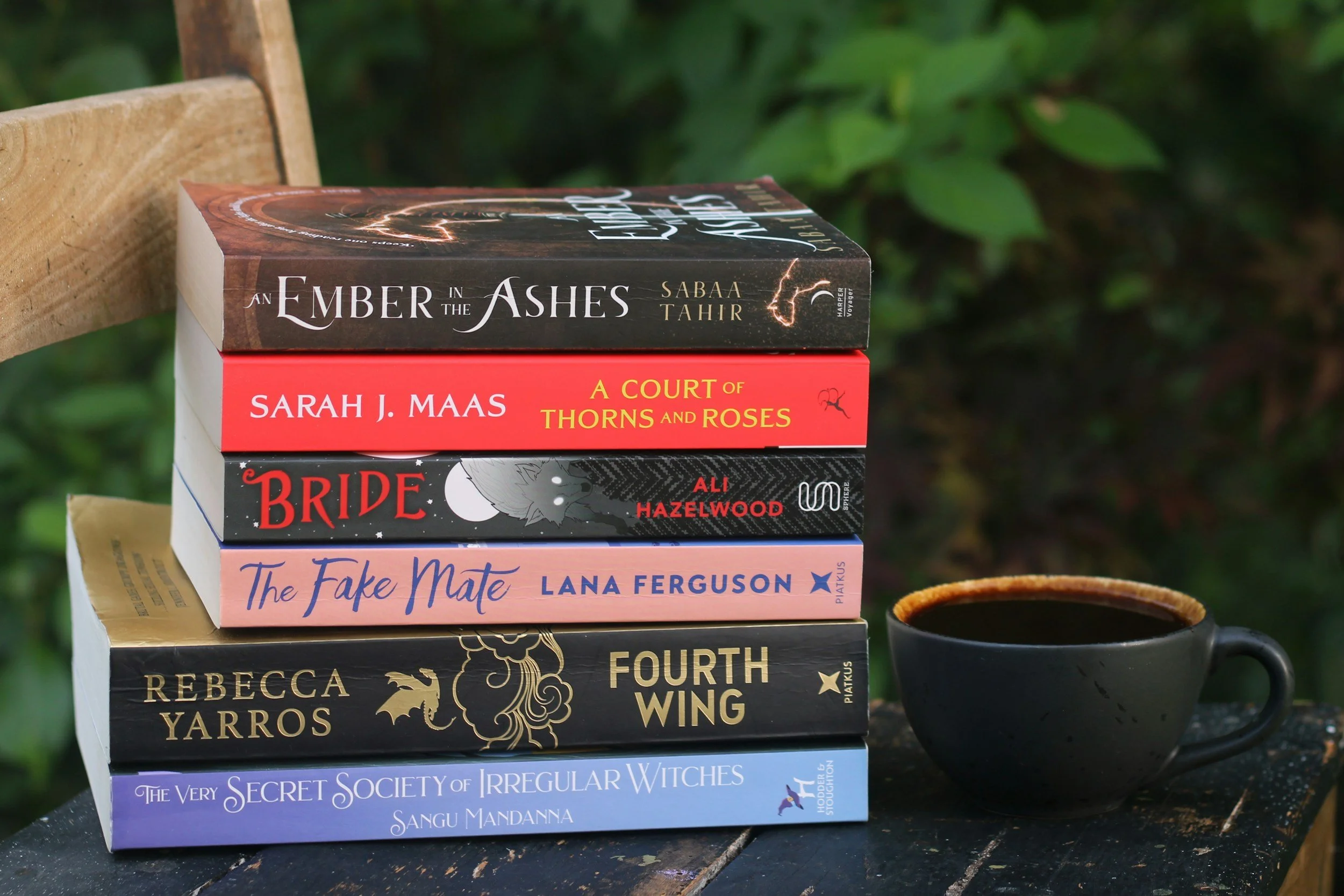
Disclaimer: this is a stock photo and I have not read any of these books
The engine that runs our world also ruined romance…
The world is wild right now. It’s just out of control bonkers. And the funny thing is that there’s a pretty consistent cause for all of these things that few people seem willing to face head-on. To learn more, just go follow Celeste Davis’ whole Matriarchal Blessing channel over on Substack. She’s my #1 recommendation for how to wake up to the engine that’s running our world. You know, in a non-conspiracy theory sort of way.
But that thing that’s destroying our world is called patriarchy. What is patriarchy? It is a social system where men are de facto in control and have most (if not all) of the power. Alongside extreme misogyny, patriarchy is further associated with unhealthy masculinity, racism, capitalism, transphobia, and all sorts of other fun [yes, sarcasm] things that are eroding our society out from under us.
And in case you’re new here, I am opposed to patriarchy because it hurts men as well as women, insofar as the patriarchal masculinity standards are impossible to uphold and men are taught to stuff down their feelings instead of expressing them. It’s just not great for anybody. Men are not taught how to be men, rather, they are taught that, at all costs, they must not be women. Isn’t that more than just a little messed up?
I was born in the ‘80s, so growing up, the romantic movies I watched were Disney classics, like Snow White, Cinderella, Sleeping Beauty, The Little Mermaid, Aladdin, and so forth. And in most of those movies, the main female character’s role is to fall in love with the male lead. But when the global narrative of the time was that the best thing women can do with their lives is find a man to marry and give them their happily ever after… maybe the world moved on, but the mindset didn’t.³
Consider what was romance back in the day: kissing unconscious women = okay! Nowadays there’s a glaring neglect of consent that we’re all hopefully aware of. Or, romance was a man wearing a woman down until she finally gave in, usually with one big romantic gesture, instead of proving in his daily words and actions that he’s a decent person. This was considered good and romantic and is one of the reasons that, for a long time, men thought that “no” meant “try harder.” It perpetuates the idea that all a man needs to do to win over a woman is ignore her boundaries and persist until she gives in. Is that the sort of relationship you admire? I sure hope not.
So, unless the writer is a very active feminist who keeps all of these things in mind, chances are, most romance is still going to fall into patriarchally coded categories, like these. For example, I was beta reading a romantasy novel this summer where the author was trying to convince me that her male lead was healthy and cared about the female lead’s boundaries, while constantly getting an inch within r*ping her.⁴ ⁵ Thing is, if your male lead talks and acts like Christian Grey from 50 Shades of Grey, you’re simply not portraying healthy relationships, and as such, I can’t root for the characters to get together.⁶ If I’m not rooting for the characters to get together, the love story has failed completely. Ergo, if your male lead is a rude, controlling, semi-abusive prick… no sale.
Romance and romantasy tropes that give me the ick…
The thing is, I actually love romance as a concept. I am a romantic at heart. But when 99% of all romance media portrays things that are inherently unhealthy and oppressive (literally, from a psychological viewpoint) as “romantic” all the time, the genre starts to lose its luster and I lose trust.
So here are a bunch of romance tropes (largely in straight couple dynamics) that gross me the fuck out, and why:
Falling in love with someone you dated for a bet, etc.: We’ve had enough She’s All That bullshit to know that women don’t generally need a makeup or to stop wearing glasses to suddenly be worthy of a man’s attention. Also, men realizing women are great while also being the type of men who will place bets on whether they can get a women… not sexy, not romantic, and in real life, men like that don’t actually usually change to be better people thanks to the love of the right secretly beautiful woman. This is usually toxic and sets an unhealthy precedent for expectations of controlling/abusive/generally shitty men to change in relationships.
Grump and sunshine: a cynical, grumpy character falls for an optimistic sunny character. Often portrayed by manic pixie dream girls and toxic boys in media, the idea is that a quirky enough woman will bring life to a stagnant, if not outright abusive male. Not generally how things work. Once again, the love of the right woman doesn’t actually magically change people’s personalities. They still have to do a lot of work.
Friends to lovers (this one can go both ways for me, but there’s often a stank to it): long-time pals realize that they’ve always loved one another. While this can happen in real life, and is generally the foundation for pretty solid relationships, it also commonly promotes the idea that men and women cannot be platonic friends for any reason. How I Met Your Mother was nightmarish on that front. In fact, men and women can be great friends, so long as the men aren’t basing the entire relationship on their potential to sleep with the woman eventually. Also, I dated a bestie for a while and it was a nightmare, so being close friends first isn’t always a guarantee.
Enemies to lovers: this is your Han Solo and Leia Organa type relationship, where the two leads bicker—the male lead is usually an arrogant prick, let’s be honest—until something changes and softens between them. It works when it’s not all about an irredeemable asshole miraculously changing his whole personality because the most perfectest woman gave him space to grow up, which is something he should have learned to do on his own. Twilight and 50 Shades of Grey are both guilty of this.
Forbidden love: your standard Romeo and Juliette story can be done well occasionally, but it’s not common. That’s because many of these stories nowadays show off power dynamic issues. If your story is about love between a man in power and a woman who works for him (think secretaries and nannies), I am immediately not interested. Most of the power structures shown in these stories (authority, gender, family) need to have the power structure dissolved for the romance to be healthy, and more often than not, this doesn’t get explored at all, let alone resolved.
Grand gestures: John Cusak holding up the boombox is a small romantic gesture, but Ross running to the airport to tell Rachel he loves her before she moves to Paris is a big romantic gesture. And like many shows and films over the years, it suggests to men that in order to win a woman over, all they need to do is make one big romantic gesture and she will forgive them and get over whatever they did… and in real life, first of all, most men aren’t willing to put in that work, and secondly, one big gesture does not undo or make up for a lifetime of BS, especially when that behavior doesn’t change.
Love triangles: honestly, just please watch this video, it says everything I need to say on the subject…
And perhaps my most loathed trope, which just so happens to be…
Fated/Soulmates: There is no more singularly unhealthy trope than the concept of “The One.” So much so, that I’m dedicating a whole segment to this…
Why “The One” is bullshit…
Now, it’s one thing if you’ve made up some fantasy reason that characters are fated, as long as it’s clear that this is fantasy. Why? Because the idea of there being only one person for all of us is probably one of the singularly most damaging ideas in the world to both men and women, on the subject of love, romance, and relationships.
Whether you’ve gotten the idea from a romantasy book, from your religion, or because one of your grandparents said it happened to them, the point I’m making here is that those people who perpetuate this myth seldom have any idea how harmful it is because they think it’s so sweet.
Those people who also preach this are often the type of people who may have felt that someone was “The One” every time they dated someone, but they only tell the story about “The One” they actually married, so many of these stories are objective lies. I thought my first love was “The One,” and my second one, and then 5ish years later, I thought a guy that I had a really unhealthy attachment to was “The One,” to the point that he sexually abused me.⁷ Nowadays, I don’t think my partner is “The One,” but rather, he’s the one I chose, and that, in my opinion, is much more meaningful. We keep choosing each other, no matter how rough things get, and I think that counts for a lot more than the idea that some cosmic force wanted us to be together.
Think about it: romantasy commonly romanticizes unhealthy relationships by promoting the idea that someone is “The One” and so you must do or be anything to make that relationship work, regardless of whether that’s in-keeping with who you are, what you want, consent, etc.
Twilight is one of the best examples of this—it’s about a blank slate of a female (Bella) who has no personality whatsoever beyond her obsession with a man that’s nearly 80 years older than her, who clearly stalks her and watches her sleep without her knowing. This is portrayed as sweet and dedicated, but it is serial killer behavior. These novels romanticized obsessive, controlling behavior, leading young girls to think that it should be desirable to have a man treat them that way. That’s not exaggeration, by the way—I have met many young girls who idealized this relationship. My only hope is that they grew out of that eventually. At least I don’t have the same views on romance that I had as a kid.
Throughout the series, Bella acts as if Edward is “The One.” Truly, that’s her whole reason for every single thing she does. It’s the reason she turns down Jacob (who actually liked her… at first), the reason she continuously flirts with suicide, the reason she wants to become a vampire… all while she has no personality or agency outside of Edward.⁸ She’s decided he’s “The One” and so she will do terrible things to herself and to others in order to keep that relationship going, including, but not limited to: lying to and hurting her father (repeatedly), estranging her friends, and suicidal behavior.
Again, this is portrayed as romantic, framed as though determination to be with someone regardless of whether they want to be with you is good, and she gets what she wants because she never gives up or never gives in. Except none of the men treat her like a human being, let alone someone with a functioning brain of her own, and all of them white knight over her while simultaneously oppressing and stalking her. Go ask a therapist if this is considered healthy relationship behavior. For reals, I’ll wait.
And yet, young women drink this in and think it’s an ideal depiction of a relationship. They want a man who is obsessed with them, stalks them… and in real life, those men are abusers who don’t care about your boundaries. They should not be romanticized.
THIS. IS. BAD.
If you read these types of stories as smut, if you read it with your brain turned on, to quote Cinema Therapy, it’s fine. If Twilight movies are your garbage TV, enjoy the brain donuts, they’re ridiculous.⁹ But they are NOT healthy depictions of relationships. In fact, if you don’t believe me, go watch Cinema Therapy’s entire coverage of those films, because it’s hilarious…
In a healthy relationship, Bella would have cared that Edward was stalking her, she’d have cared that he was controlling, and she’d have cared that he and his entire family have the potential to kill her at any given moment. All of these would be relevant things to ponder and consider when going into this relationship.
But Bella has no personality beyond thinking that Edward is oh so hot. It’s treated as desirable, to have a man who is obsessive and controlling, because, as I already mentioned, he’s “The One.” She even says it to Jacob at some point in the films: “don’t make me pick between you, because it’s always been him.” It’s supposed to feel romantic, but it’s just… unhealthy. I mean, neither of them were a good choice, but between the two, Jacob was an improvement, even if he also proves to be just as obsessive and controlling as Edward in the end.
The main problem with the concept of “The One” is agency in itself. Having a singular soulmate is a nice idea, but it’s impractical and unrealistic, because it implies that the universe will just drop this person at your feet someday, without you ever having to do any work to find that person, then build a connection and eventually a relationship, or do any work to make that relationship function like a true partnership. It’s wish fulfillment that believes in the myth of happily ever after, which is a trick patriarchy plays to make women believe that the only worthwhile outcome of their life is to find a man.
Consider Ross Geller and Rachel Green in Friends. Their whole arc is about how Ross has believed that Rachel was “The One” for much of his life, and thinks he’s owed her because he wants her so badly, despite putting in very little effort to care about the things that matter to her. He’s deeply manipulative, pushing her away from male friends, insulting her because she didn’t have a career but then pushing her away from the career to prioritize their relationship (like how she gave up her dream job in France to stay with him in the finale), and acting like a petulant child whose parent took his toy away anytime she dates someone else.
Ted Mosby in How I Met Your Mother is worse, acting like a grand romantic gesture is the answer to everything, which leads him to some serial killer -like behavior and forcing his way into a woman’s home at least once when she clearly wants him to leave (S01E04).
In The Big Bang Theory, Howard sexually harasses Penny constantly, as if he’s owed love and sex from her just for being friends with her, and when she finally gets fed up with it and tells him what a creepy PoS he is, Leonard coerces her into apologizing to Howard (S02E12). What the actual shit!?
Or if you want to see the most terrifying one that I can think of, watch all of Boy Meets World, where Cory believes that Topanga is “The One,” and when he cheats on her, he reacts violently when she says it changed their relationship, after which he forces her to coddle his emotions, while endlessly ignoring her hurt and prioritizing his feelings about not getting what he wants. She ends up giving up all of her dreams and goals to be with him and they get married when they’re still teenagers. I expect that story to play out with Topanga being dead within 10 years of that marriage, because Cory, even as a teenager, reacts violently when he’s upset that their relationship isn’t going the way he wants it to. It bodes poorly for her, if you look at real life history.
Yet, when you’ve heard someone, like my own grandmother, saying that she knew she was going to marry my grandfather the first time he put his arm around her, you think it’s cute and you want that for yourself because they’ve given you the impression that this is normal and will happen to everyone. That you’ll “just know.” Well, not everyone shows their true colors up front, and abusers are known for being charming a lot of the time. Ergo, this implication is actually scary as hell when compared to reality.
This is why it’s so hard to do modern remakes of films like Snow White, because if we assume that “The One” is real and that Snow White met him earlier and they fell in love (again, assuming that love at first sight is real, and let’s be very clear — it is not), then it’s fine that he kisses her to wake her, because he’s her one true love. But when we realize that “The One” isn’t a real thing, it suddenly becomes a horror film. …Actually, now that I say it, that’s a modern remake of Snow White that I’d like to see!
Soulmate stories are further upsetting, because they invalidate choice. This is a key point: we choose the people we love and we keep choosing them. But love alone isn’t enough to build a life together. It’s a good start, certainly. You have to want the same future, have goals that align, etc. It’s like I said in my article about the ending of How I Met Your Mother: Ted and Robin had very good reasons to not want to be together (wanting different things out of life, like bringing new life into this world), which is why many viewers never understood why they should be rooting for them in the end.
I’m over 40 now. Do you have any idea how many women (and even the odd man) I’ve seen stay in toxic/abusive relationships because they thought their partner was “The One”? Do you know how many people I see pass up potentially great relationships, because there wasn’t an initial spark of limerance, so they write it off completely? Do you know how many women I know, who are even older than me, who still dream of a white knight to carry them away?
Too friggin’ many.
What I want for my friends, and for the characters I write in the romances in my own novels, are relationships with characters on equal footing. This is why, if you read my fiction, you’ll note that my two main characters fall in love in the first two books of a 10+ book series. Why? Because I want to show that people who do connect and build healthy relationships will still struggle because life will constantly throw curveballs at you. Just because you have a killer instant spark and awesome sexual chemistry doesn’t mean you can survive the death of a loved one or a chronic illness or serious injury, or other crazy things that we assume won’t happen to us, but ultimately do, because that’s life.
Exceptions to these rules…
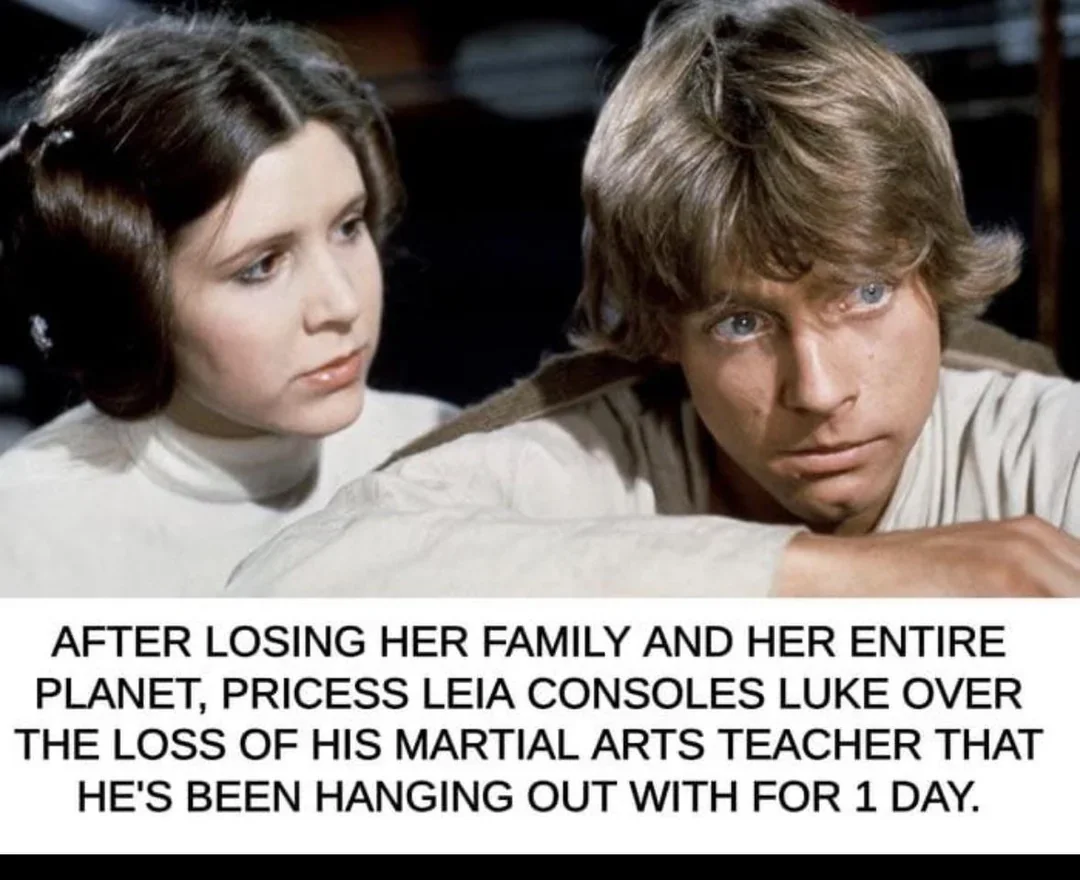
My issue with the above-listed tropes usually relates to the handling of men and women. Have you ever seen this meme from Star Wars? Even though it’s not from a romantic point-of-view, it still shows why I find a lot of these romantic tropes to be irritating:
That said, sometimes there are films that portray the above-loathed tropes, but do it without invoking my hardcore ick factor, so I feel compelled to shout them out (and these might cause ick in other people for other reasons, and that’s also valid):
10 Things I Hate About You: Patrick is paid to take out Kat by a rich douchebag who wants to sleep with Kat’s younger sister. I hate the paid to date someone trope, but Heath Ledger’s vulnerability really sells him as a guy who wasn’t a bad person to begin with; he’s actually quite nurturing per his backstory and is just putting on a show so his classmates will leave him alone. He was just happy to get some money from the actual asshole, but when he realized he was hurting someone he was starting to genuinely care about, he did try to stop it, he just didn’t really shut it down until the damage was already done — not unrealistic for a teenager. He also works to make it up to Kat in the end, by using the money he made to buy her something she’s dreamed of having (a Fender Stratocaster).
Also, is it possible not to love Patrick after this grand gesture? I hate grand romantic gestures as a rule, but in this case, I find it charming. He’s not running to an airport to stop her from leaving the country (ick), he’s not hoping she’ll give up on her dreams of going to an east-coast college for him (ick), he just realizes that because Kat was embarrassed because of him, he wants to even the playing field, so he does something equally embarrassing to put them back on equal footing. Like serenading her in front of the entire school. Doesn’t seem like something a guy who only wants money would do. Just, in real life? Don’t expect this sort of thing from anyone.
The Wedding Singer: possibly ranking amongst Adam Sandler’s least-cringey movies, this is a friends-to-lovers film, but in a way that’s actually charming. Yes, Julia is dating a patriarchal douchebag and Robbie is meant to be the likeable foil, but this movie focuses on the genuine fun and connection the two characters build when they spend time together, and the miscommunications and insecurities that hold them back. It does get a little brutal in there when Robbie’s insecurity over not being as successful as her fiancé comes to the surface, but ultimately, he immediately recognizes that he was projecting his fears onto her and that he was being an asshole.
Tristan & Isolde: This was a favorite from when I was a teenager and admittedly, I hadn’t watched it in ages, so I decided to watch it again recently to see if it holds up. This film was pitched as a Romeo and Juliette story that predates Shakespeare’s, and admittedly, the film does actually do some work to update the premise, like removing the awful trope of the love potion. Even though there is a love triangle and fated lovers, it’s not just forcing a woman to pick between a good guy and a douchebag (and in a lot of rom-coms, the woman usually picks the douche in the end? Looking at you, Sweet Home Alabama and The Notebook). This film establishes the connection between Tristan and Isolde before she’s betrothed to Lord Marke, so the viewer understands the pain that both characters are going through, because everyone recognizes that Isolde was sold to the victor of a tournament (ergo, she wasn’t able to choose for herself), while Marke is a good guy and doesn’t deserve to be cuckholded. It’s a realistically uncomfortable situation where two people are in love but they are simultaneously aware that their relationship’s existence — per the world they live in — is doing more harm than good.
The Holiday: While I do have my issues with the England side of the story (if a dude slept with a lonely drunk woman, it’d be predatory, so it’s valid the other way around too), I genuinely enjoy the slow-build relationship between Iris and Miles in this film. It’s Jack Black at his most charming and he manages to work really well with Kate Winslet, who is a legend. Their entire relationship is built on their mutual understanding of unrequited love and picking people who don’t deserve or reciprocate their love and dedication. Plus they just have hella cute and charming energy together.
Marshall & Lily in How I Met Your Mother: I have a lot of issues with this series and how it treats women, as you may have clocked, but I nevertheless remember Lily and Marshall as one of the few couples in TV who actually have a strong relationship and show what happens after happily ever after. They’re already together at the start of the show, they break up early on largely because neither of them has experienced adult life without the other, and they quickly get back together because they realize life with other people isn’t as good as life was when they were together. It’s a mutual decision, and they still fight and have it out regularly, but they constantly work through their issues, they both take accountability (sometimes, at least, like in the scene below), and constantly choose one another throughout the series, no matter what they face together.¹⁰
Is there a romantic gesture that hasn’t been ruined by patriarchy?
I’d actually love to hear your thoughts on this, because my partner would love to do romantic things for me, but all the usual suspects are so tainted by patriarchal expectations that things like flowers, chocolates, and date nights, that they feel more exploitative than sweet. Just look at how many men think women owe them sex or intimacy because they offer romantic gestures. It results in romantic gestures becoming off-putting as a whole. I’d much rather be with a man who makes dinner every night, than one who spends too much money on a night out irregularly.
And, unfortunately, most of us aren’t in places where men can step up in big ways like are represented in movies or shows. Most men don’t have the chance to run across an airport (and if they did, they’d still need to get through security and all that) to stop someone from leaving. More and more women want to hold men accountable for their actions, rather than forgive them because they do one nice thing one time. In fact, if you look at the science, most women appreciate small gestures over time rather than singular big gestures. Those little things are what make up a life together.
In my fantasy series, it’s important to me that my MMCs (male main characters) adore their partners. They’re absolutely crazy about them and support them in any decision-making, and want what’s best for them no matter what, even if that means not being with said MMCs. But I also try to make it clear that romance is a big part of life but it’s not the be-all-end-all aspect of life. Finding love isn’t the end-game for my characters, it’s just part of… the game. In some Volumes, it’s the most important part. In others, it’s just day-to-day life.
So, what are your thoughts? I know many of these tropes are still deeply popular, and that while we recognize these tropes as being unhealthy, sometimes (as listed above), they can be done well, without the lingering ick. Do you feel the ick in some of the films I’ve forgiven? Do you love some of the romances that I hate? Do you know of any romantasy books that don’t use these unhealthy depictions of relationships? If so, let me know down below!
And remember to love yourself as much as you want someone to love you! 💞🐻
1. Cozy tales with romance do not count as romantasy to me. Romantasy, IMO, is Harlequin romance in a fantasy setting, nothing less, nothing more.
2. Romantasy is often considered a genre by women, for women, and I am all for that!
3. No shade intended here, either. Societal conditioning runs really deep and I still find creative ways that patriarchy and woman-hating has snuck into my mindsets.
4. Quick note here: If your male lead says something like, “I want you to want me, not be forced to want me because of our fated bond,” but then never once in his actions respects the woman’s boundaries, requests, or autonomy, he’s almost certainly going to seem like a r*pist in your book and that brings up really messed up questions about “fate” in your “fated bond” tale.
5. Furthermore, I’m not saying you shouldn’t write stories like this. I’ll never kink-shame anyone. But if you are going to write a story that edges with questionable consent, you should probably write a trigger warning. Enough of us have been assaulted and coerced that reading this sort of romantasy without being forewarned can bring up some really fucked up memories that we don’t want to revisit.
6. I’m usually rooting for the woman to run to the hills, actually.
7. It’s less cute and funny and whimsical when it happens to you IRL. And romantasy doesn’t usually cover the emotional devastation and external judgment, among other things, that comes from coercion.
8. If you can name one clear personality trait for Bella that has nothing to do with Edward, you win a prize. Just kidding, she has none.
9. I really enjoy the first film in that series because it’s goofy and awful and I think it’s hilarious that Edward looks like he’s shitting himself when he first sees Bella. Vampire baseball was actually kinda charming in a dumb sort of way. I’ve watched it multiple times. I enjoy it, it’s a stupid, fun film.
10. Barney Stinson is a full-fledged r*pist. Sexual coercion is r*pe, ergo…
Looking for an editor? Consider giving Bear a chance to nitpick your book into being the best it can be!
Or, for more writing tips and to stay up-to-date on Bear’s own fantasy projects…
